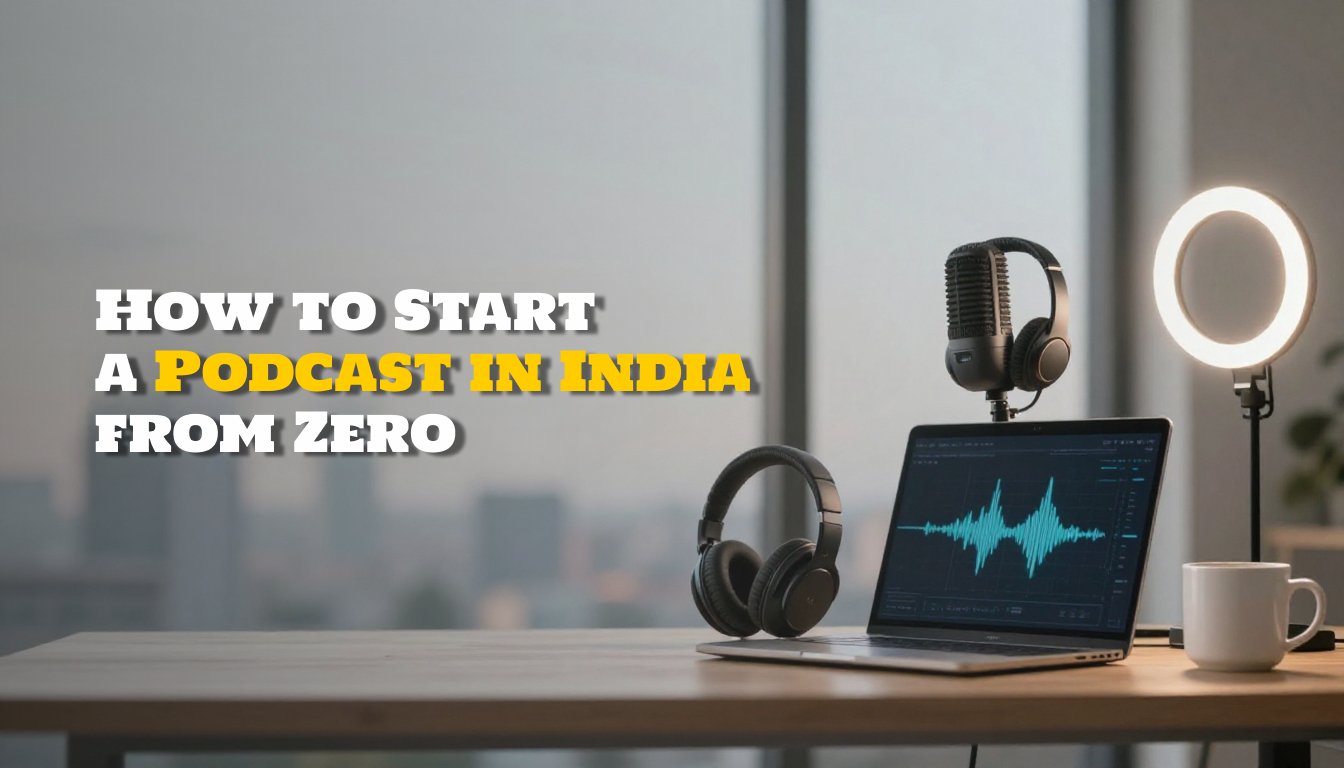
How to Start a Podcast in India from Zero — Equipment, Cost, Monetisation & Mistakes to Avoid
In 2026, a podcast is no longer just a mic and a conversation. It is influence, distribution and long-term brand equity.
Walk into any college campus, co-working space or corporate boardroom today and you’ll hear the same word: podcast.
India is listening. But more importantly, India is starting to speak.
According to the PwC Global Entertainment & Media Outlook, India is among the fastest-growing audio markets globally. Industry estimates suggest that India’s podcast listener base has crossed 100 million, with steady year-on-year growth driven by regional language content.
Meanwhile, data from KPMG highlights that digital audio advertising in India is expanding at a strong double-digit growth rate, fuelled by increased smartphone penetration and affordable data.
The opportunity is clear.
But how does someone start a podcast in India from zero — with no studio, no experience and no celebrity status? Let’s break it down practically.
Step 1: Clarity Before Equipment
The biggest mistake beginners make?
Buying expensive gear before defining purpose.
Ask yourself:
- Who is my audience?
- What problem am I solving?
- Am I building authority, community or entertainment?
- Is this personal branding, business marketing or pure storytelling?
A podcast without positioning becomes background noise.
In 2026, niche wins over noise.
Step 2: Equipment — What You Actually Need
Let’s simplify it.
1. Microphone
You don’t need a ₹50,000 studio mic on Day One.
Reliable starter options in India:
- USB condenser microphones (₹3,000–₹8,000 range)
- XLR dynamic microphones (₹7,000–₹15,000 range) for better sound control
2. Headphones
Closed-back monitoring headphones (₹1,500–₹4,000)
3. Audio Interface (if using XLR mic)
Entry-level interface: ₹7,000–₹12,000
4. Recording Software
Free options:
- Audacity
- GarageBand
Paid options:
- Adobe Audition
- Logic Pro
5. Recording Space
Here’s the truth:
Sound treatment matters more than mic price.
A quiet room with curtains, cushions and minimal echo can outperform an expensive mic in a reflective room.
Estimated Starter Cost (India)
| Setup Type | Approx Cost |
| Basic Home Setup | ₹5,000 – ₹15,000 |
| Semi-Pro Setup | ₹20,000 – ₹40,000 |
| Studio Production | Depends on per-session cost |
For many serious creators and brands, professional studios reduce long-term trial-and-error.
This is where structured spaces like DigiCrow Studio become relevant — not just for recording, but for positioning, lighting, editing and distribution strategy
Step 3: Format & Duration
Podcasting in India has evolved.
Data from global streaming platforms such as Spotify shows that listener retention improves when content is structured and consistent.
In India:
- 20–40 minutes works well for solo informative episodes.
- 60–90 minutes suits conversational interviews.
- Short-form clips (30–90 seconds) drive discovery on Instagram & YouTube Shorts.
Long-form builds trust.
Short-form drives reach.
You need both.
Step 4: Distribution — Where to Publish?
A podcast today is not “audio only”.
You should distribute on:
- YouTube
- Spotify
- Apple Podcasts
- Google Podcasts
- Instagram (Clips/Reels)
YouTube, in particular, has become a major discovery engine for podcasts in India because video podcasts generate both watch time and ad revenue.
Step 5: Monetisation — When & How Does Money Come?
Let’s be honest.
Your first 10 episodes may earn nothing.
Podcast monetisation usually begins after credibility and consistent viewership.
Primary income models in India include:
1. Brand Sponsorships :
Local brands often sponsor niche podcasts before national brands do.
2. Integrated Promotions :
In-episode brand mentions.
3. YouTube Ad Revenue :
Depends on watch time and subscriber base.
4. Event & Speaking Invitations :
Podcasts build authority, which builds offline opportunity.
5. Business Funnel :
Many founders use podcasts to attract consulting clients.
Industry reports indicate that brands increasingly prefer conversation-led branding over banner ads because trust conversion is higher.
A well-positioned podcast becomes a long-term asset, not just content.
Step 6: The Biggest Mistakes to Avoid
After observing hundreds of podcast launches, here are the most common failures:
❌ Starting Without Consistency Plan
Excitement lasts 3 episodes. Discipline sustains 100.
❌ Ignoring Audio Quality
Viewers forgive average video. They don’t forgive bad audio.
❌ No Hook in First 30 Seconds
Retention drops sharply without a compelling start.
❌ No Clip Strategy
If you’re not repurposing long-form into short-form, you’re invisible.
❌ No Branding
Podcast is not just a talk. It is a visual identity.
❌ No Monetisation Thinking
Waiting for 1 lakh subscribers before planning revenue is unrealistic.
Step 7: Building It Like a Professional
Here’s the difference between hobby podcasters and serious hosts:
| Hobby | Professional |
|---|---|
| Random guests | Strategic guest positioning |
| Casual recording | Structured production |
| No distribution plan | Multi-platform rollout |
| No data tracking | Analytics-driven decisions |
Podcasting in 2026 is media entrepreneurship.
Why Studio & Strategy Matter
Many first-time podcasters struggle not because of lack of ideas — but because of lack of system.
Professional podcast studios today offer:
- Multi-camera recording
- Broadcast-grade audio
- Structured lighting
- Editing support
- Thumbnail & SEO optimisation
- Clip strategy
- Brand integration framework
A structured ecosystem like DigiCrow Studio doesn’t just record episodes.
It helps build a show.
And building a show is different from uploading a video.
Is Podcasting Worth It in India?
If you are expecting overnight fame — no.
If you are willing to build long-term authority — absolutely.
India’s digital growth is regional, conversational and trust-driven.
Podcasts offer depth in an era of distraction.
For Hindi-speaking audiences especially, conversations feel more authentic than scripted ads.
That’s why institutions, educators, entrepreneurs and even policymakers are embracing the format.
Final Word
Starting a podcast in India from zero is easier than ever.
Smartphones are affordable.
Internet is cheap.
Audience is growing.
Brand budgets are shifting.
But clarity, consistency and structure remain non-negotiable.
A mic can start a podcast.
A strategy builds a platform.
If you are serious about podcasting as a career, business or influence channel, start simple — but start structured.
Because in 2026, podcasting is not a trend.
It is media ownership.
And those who own conversations, own attention.